
 ultimate-guide
How to Spot Quality Furniture Online: A 2026 Guide
Table of Contents
- Why Spotting Quality Furniture Online Matters
- Solid Wood vs. Particle Board Furniture: What You Need to Know
- Best Furniture Construction Methods to Look For
- How to Read Furniture Product Specifications for Quality Markers
- Evaluating Upholstery, Fabric, and Cushion Quality
- Digital Verification Tools and Online Research Strategies
- Warranty, Return Policies, and Craftsmanship Indicators
- Quality Furniture for Every Budget and Space Type
Last Updated: August 24, 2026
Why Spotting Quality Furniture Online Matters
Buying furniture without sitting on it first feels like ordering a meal blindfolded. You can't test the comfort, can't run your hand across the fabric, and can't feel whether the frame wobbles. Yet millions of people do it every year, and many end up with pieces that look great in photos but fall apart after six months.
The difference between a furniture purchase that lasts a decade and one that disappoints after a year often comes down to knowing what signals quality. When you're shopping online, you're working with limited information: product photos, descriptions, and reviews from strangers. Station Home Design understands this challenge, which is why we've built our entire curation process around identifying pieces that deliver on both aesthetics and durability. Below, we'll show you exactly how to read the signals that separate investment-worthy pieces from quick-wear furniture, even when shopping entirely online.
Solid Wood vs. Particle Board Furniture: What You Need to Know
Solid hardwood is the foundation of furniture that lasts. When a piece is constructed from solid wood, oak, walnut, or acacia, you're getting material that can be refinished, repaired, and repurposed. Particle board and MDF (medium-density fiberboard) are compressed wood byproducts that cannot be refinished and deteriorate when exposed to moisture or repeated stress.
A solid wood frame can support weight for decades. A particle board frame starts breaking down the moment the glue holding the particles together absorbs moisture from humidity or spills, resulting in creaking, wobbling, or visible separation at joints.
When reading product descriptions online, look for these specific phrases:
- "Solid hardwood frame", this is what you want
- "Kiln-dried wood", indicates proper drying to prevent warping
- "Engineered wood" or "composite", often particle board or MDF dressed up with a better name
- "Veneered", a thin layer of real wood glued to a particle board core; acceptable for tabletops but not structural frames
Veneered pieces can still be quality furniture if the veneer is thick and the underlying structure is solid. Thin veneer over particle board is where problems start. Reputable retailers specify veneer thickness and what's underneath.
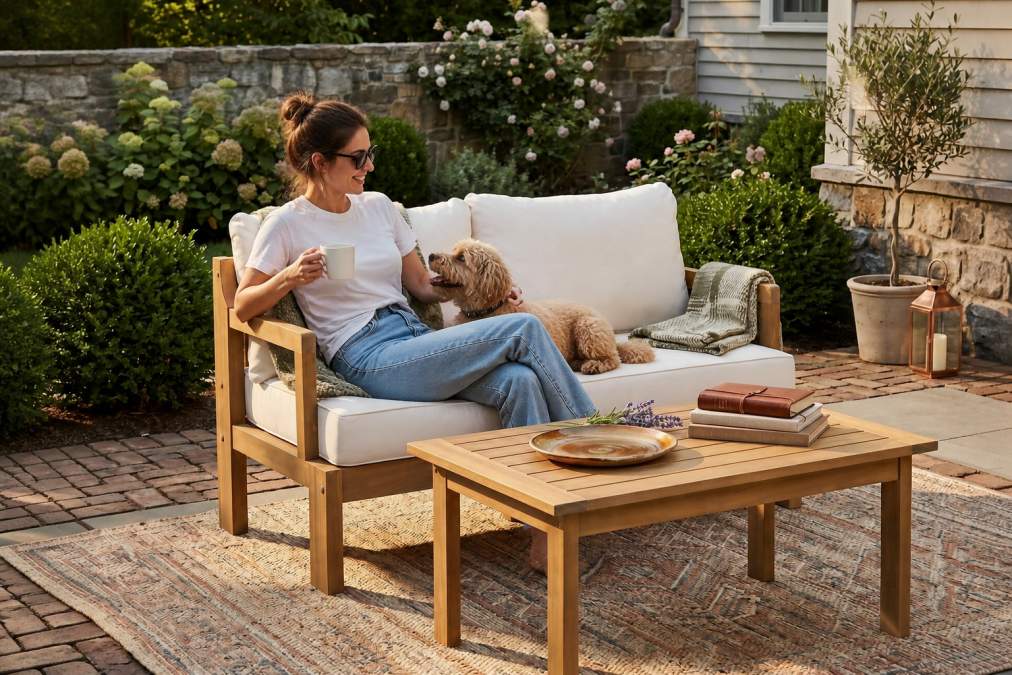
Station Home Design's curated selection prioritizes solid wood construction. Our Outdoor 2-Piece Acacia Wood Patio Chat Set uses solid acacia wood specifically chosen for its natural durability and weather resistance, not particle board with a wood-grain finish.

Best Furniture Construction Methods to Look For
Quality construction separates furniture that holds up from furniture that doesn't. Three specific joinery methods signal craftsmanship: dovetail joints, mortise-and-tenon joints, and reinforced corner blocks.
Dovetail and Mortise-and-Tenon Joints
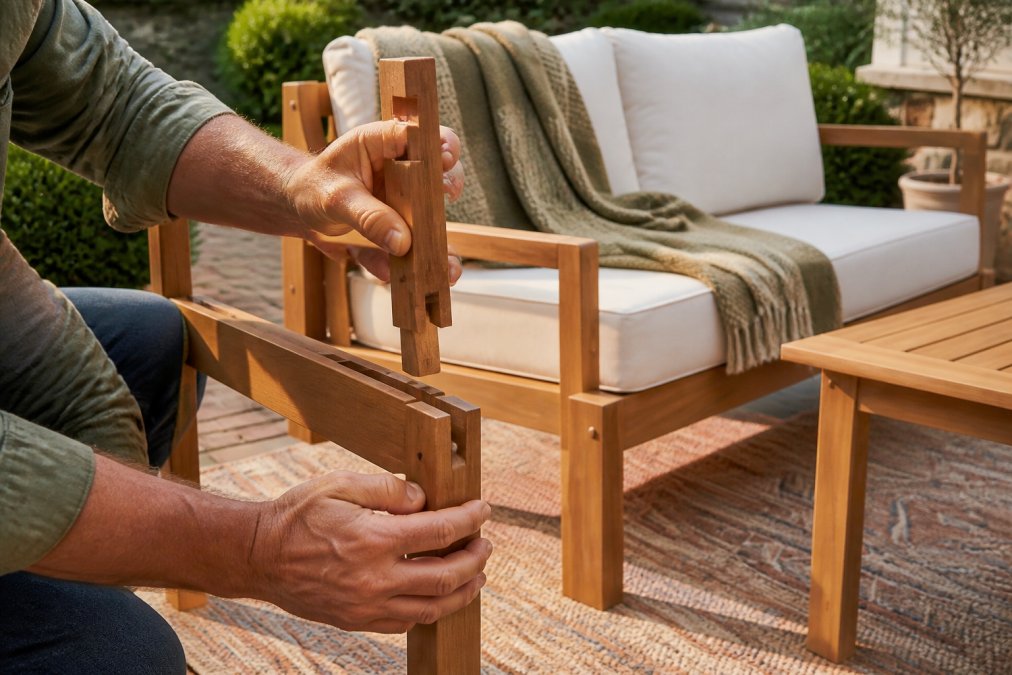
Dovetail joints are the gold standard for drawer construction. You'll see interlocking fingers of wood that fit together without nails or screws. This joint distributes weight evenly and prevents drawers from racking (twisting out of square) over time. Mortise-and-tenon joints work similarly for frame construction, with a projecting piece (tenon) fitting into a cavity (mortise) and typically reinforced with glue and dowels.
Both methods are labor-intensive, signaling quality over speed. When reviewing furniture online, look for close-up photos showing how drawers connect to the frame. If you can see the wood-to-wood connection without visible gaps, you're looking at solid joinery.
Corner Blocks and Load-Bearing Frames
Corner blocks are reinforcement blocks glued and screwed into the inside corners of furniture frames. They prevent the frame from racking under load and are a hallmark of well-made pieces. When examining product photos online, look for:
- Photos showing the underside or interior of the frame
- Visible corner blocks at all joints
- Screws (not staples) holding blocks in place
- A solid wood frame, not particle board
Load-bearing capacity matters more than you'd think. A sofa frame rated for 300 pounds per seat will outlast one rated for 150 pounds. Check product specifications for weight capacity and compare it to your actual use case.
How to Read Furniture Product Specifications for Quality Markers
Product descriptions are where manufacturers either commit to quality or hide behind vague language. Learning to read them is the single most useful skill for spotting quality furniture online.
Start by looking for specificity. A quality manufacturer will list:
- Exact wood types and whether they're solid or veneer
- Foam density (measured in pounds per cubic foot)
- Fabric specifications including rub count
- Hardware materials (steel vs. plastic)
- Weight capacity for seating
- Warranty length and coverage
Compare this to a vague description: "Premium sofa with quality materials." That tells you nothing. You can't evaluate quality without data.
Wood: Look for "solid" paired with a specific hardwood name. "Acacia wood frame" is better than "wood frame." "Kiln-dried" indicates proper moisture control.
Joints: Search for "dovetail," "mortise-and-tenon," or "corner blocks." Their presence is a strong signal.
Upholstery: Specifications should mention fabric type, weight, and durability rating.
Hardware: Hinges, legs, and fasteners should be specified by material. Steel is better than plastic.
Warranty: A 5-year warranty suggests the manufacturer expects the piece to last at least that long. A 1-year warranty might indicate lower confidence in durability.
Many retailers, including Station Home Design, provide detailed specification sheets for each piece. If a retailer doesn't, that's a red flag.
Evaluating Upholstery, Fabric, and Cushion Quality
Upholstery determines comfort, durability, and how well a piece will age. Two factors matter most: fabric durability and cushion construction.
Fabric Durability and Rub Count
Rub count measures how many times a fabric can be rubbed back and forth before it shows wear (astm.org). This number, measured in double rubs (one back-and-forth motion counts as two rubs), indicates durability.
Here's what different rub counts mean in practice:
- 10,000-15,000 rubs: Light use (bedrooms, formal living rooms)
- 15,000-30,000 rubs: Moderate use (family rooms, dens)
- 30,000+ rubs: Heavy use (high-traffic areas, homes with kids or pets)
When reading product descriptions, look for the specific rub count. If it's not listed, the fabric might be lower-quality or the retailer might not be transparent about durability.
Fabric type also matters. Natural fibers like linen and cotton are beautiful but less durable than synthetics like polyester or nylon. Performance fabrics, engineered specifically for durability, are increasingly common and worth the premium for heavy use.
Foam Density and Spring Systems
Cushion comfort and longevity depend on foam density and the underlying support structure. High-resilience foam (HR foam) is denser and more durable than standard foam, measured in pounds per cubic foot (PCF) (astm.org). A foam with 2.5 PCF density will compress and lose shape faster than one with 4.0 PCF density (peer-reviewed research).
Spring systems include:
- Eight-way hand-tied springs: Premium construction where springs are individually tied to the frame. Expensive but lasts decades.
- Sinuous springs: Metal wire springs in an S-shape. Durable and mid-range in cost.
- No springs (foam-only): Lighter weight and lower cost, but less support and shorter lifespan.
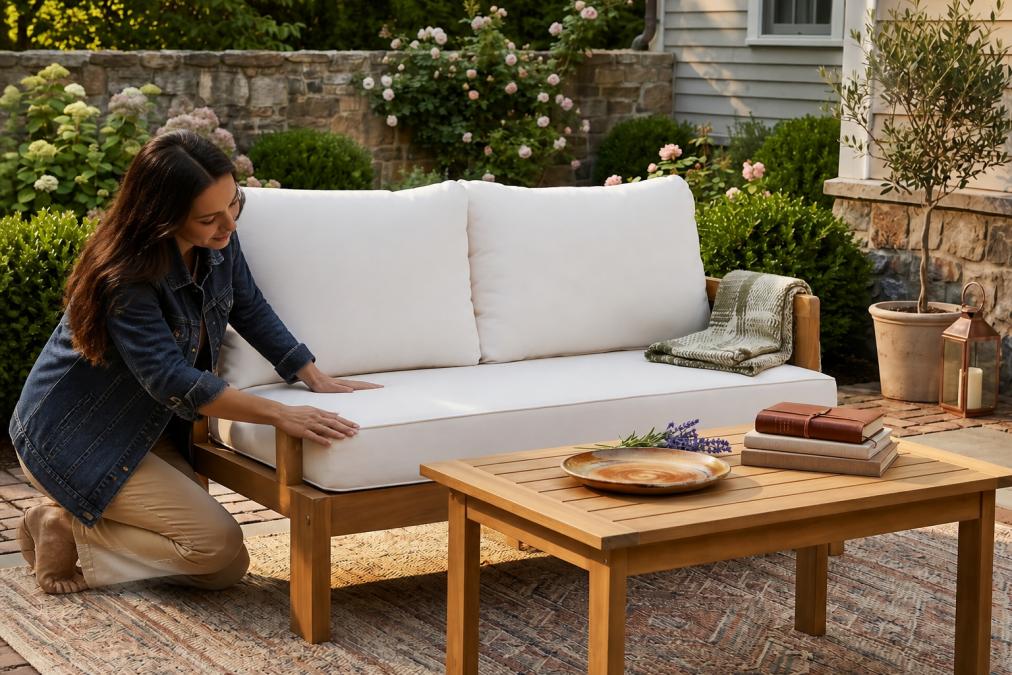
When evaluating cushions online, look for foam density specifications (4.0 PCF or higher is solid), mention of spring systems, tight even stitching, and removable washable covers. The best cushions combine multiple layers: a spring system for support, high-density foam for comfort, and a quality cover for durability.
Digital Verification Tools and Online Research Strategies
You're limited to photos and descriptions when shopping online, but there are ways to verify quality beyond the product page.
Video content is your best friend. Many retailers now provide videos showing furniture construction, materials, and unboxing. Watch these carefully. Does the wood look solid or flimsy? Are joints visible and tight? Does the fabric feel textured and substantial?
Customer reviews on independent platforms provide real-world feedback. Look for patterns in complaints. If multiple reviews mention "frame started creaking after three months," that's a signal. Positive reviews often mention specific durability details that confirm the product description.
Sustainability and material sourcing are increasingly important indicators of quality. Manufacturers committed to responsibly sourced materials tend to invest in overall quality. Look for certifications like FSC (Forest Stewardship Council) for wood or OEKO-TEX for fabrics. These suggest the manufacturer cares about long-term reputation.
For second-hand and vintage furniture, request multiple angles, close-ups of joints, and details showing any wear or damage. Ask about the piece's age and original use case.
Warranty, Return Policies, and Craftsmanship Indicators
A strong warranty and generous return policy suggest confidence in quality and protect you if something arrives damaged or doesn't match the photos.
Warranty length and coverage vary widely. A 5-year structural warranty covers frame defects but might not cover fabric stains. A 10-year warranty on frame and joints is more substantial. Read the fine print carefully.
Return policies matter more for online furniture than in-store purchases. You need time to inspect the piece, check fit in your space, and verify quality. A 30-day return window is standard but tight. A 60 or 90-day window gives you real time to evaluate. Station Home Design stands behind its curated selections with clear return policies.
Craftsmanship signals include named designers or craftspeople, detailed origin information, transparency about materials and construction methods, willingness to answer specific questions about durability, and photos showing construction details. Retailers that hide behind generic descriptions and don't answer questions are often cutting corners.
Quality Furniture for Every Budget and Space Type
Quality doesn't require a luxury budget. You can find well-made furniture at different price points if you know what to prioritize.
For tight budgets: Focus on solid wood frames and avoid particle board entirely. Prioritize structural integrity over cushion comfort or fabric luxury. A simple solid wood chair with basic upholstery will outlast a trendy particle board sectional.

For moderate budgets: This is where you can access furniture with solid wood frames, quality joinery, and better upholstery. Station Home Design's curated selections combine solid acacia wood construction with thoughtful design that works across multiple spaces.
For premium budgets: You're accessing furniture with exceptional craftsmanship, premium materials, and long warranties. Eight-way hand-tied springs, high-resilience foam, performance fabrics, and solid hardwoods become standard.
For renters and temporary spaces: Don't assume you need cheap furniture. Modular pieces, quality vintage finds, and simple solid wood items often work better than disposable furniture and are easier to move.
The key across all budgets is prioritizing the fundamentals: solid wood frames, quality joinery, and honest material descriptions. A beautiful piece that falls apart in two years is the worst value of all.
Finding quality furniture online requires learning to read the signals manufacturers and retailers send through specifications, photos, and materials. You're looking for solid wood frames, quality joinery methods like dovetail joints and corner blocks, honest upholstery specifications, and retailers willing to be transparent about construction. Station Home Design curates pieces specifically for durability and timeless design, removing the guesswork from your shopping. When you know what to look for, you can confidently invest in furniture that will actually look good and feel solid five, ten, or twenty years from now.
Frequently Asked Questions
Q: What materials indicate high-quality furniture?
A: Solid hardwood like oak, walnut, and maple signals quality construction. Kiln-dried wood resists warping and cracking. High-resilience foam in cushions lasts longer than low-density alternatives. Look for eight-way hand-tied springs in upholstered pieces and solid wood frames rather than particle board or MDF. Quality fasteners (screws over staples) and corner blocks reinforce joints. Avoid veneer over particle board, which deteriorates faster than solid construction.
Q: How can you tell if a sofa is well-made online?
A: Check product descriptions for frame material (solid hardwood is best), mention of kiln-dried wood, and spring system type. Read customer reviews mentioning durability and structural integrity. Examine high-resolution photos for tight stitching, even fabric grain matching, and visible corner blocks. Look for warranty length, manufacturers confident in quality typically offer 3-5 year coverage. Request detailed specifications about foam density, upholstery grade, and assembly methods before purchasing.
Q: What is the difference between solid wood and veneer furniture?
A: Solid wood furniture uses actual hardwood throughout the frame and visible surfaces, offering durability and longevity. Veneer applies a thin layer of quality wood over a substrate like particle board or MDF, reducing cost but potentially compromising durability. Veneer can look identical to solid wood online, so check product descriptions carefully. Quality veneer over solid wood frames is acceptable, but veneer over particle board deteriorates faster. Solid wood pieces withstand refinishing and last generations; veneered pieces are harder to repair.
Q: Why is joinery important in furniture construction?
A: Joints determine whether furniture holds together under daily use. Dovetail joints and mortise-and-tenon connections are hallmarks of quality craftsmanship, distributing stress across wood grain. Poor joinery using nails or weak glue leads to wobbling, creaking, and structural failure. Corner blocks reinforce joints further. When evaluating online, product descriptions mentioning specific joinery types signal attention to durability. Photos showing visible joints (especially in drawers) indicate transparent construction quality. Strong joinery is why quality furniture costs more but lasts decades.
Q: What should I look for in online furniture product descriptions?
A: Prioritize material specificity: solid hardwood species, kiln-dried wood, upholstery weight, foam density (measured in pounds per cubic foot), and spring system details. Look for construction method descriptions like eight-way hand-tied springs or mortise-and-tenon joints. Check weight capacity ratings and finish durability claims. Reputable sellers list dimensions, assembly requirements, and care instructions. Vague descriptions like 'quality materials' or 'premium construction' without specifics suggest corners cut. Compare descriptions across sellers, detailed specs indicate confidence in product quality.
Q: Are online furniture reviews reliable for judging quality?
A: Customer reviews reveal real-world durability and assembly experiences. Look for patterns: multiple mentions of structural integrity, creaking, or wobbling suggest frame problems. Reviews praising comfort and stitching quality are valuable. However, reviews don't always assess construction depth, focus on long-term feedback (6+ months) over initial impressions. Cross-reference reviews with product specifications. Watch for reviews mentioning specific defects like loose joints or fabric pilling. A piece with 100 five-star reviews and zero critical feedback may be filtered; balanced reviews with constructive criticism tend to be more trustworthy.
Q: How do I know if furniture will look good in my space before ordering?
A: Request multiple product photos from different angles and lighting conditions. Ask sellers for lifestyle images showing pieces in real rooms. Check dimensions against your space measurements, use painter's tape to outline furniture footprints on your floor. Review color swatches if available. Read reviews mentioning how colors appear in different lighting. Many quality retailers offer generous return windows (30-60 days) so you can evaluate fit and aesthetic in your home. Take advantage of this, it's how online shopping works best for furniture.
This article was written using GrandRanker
Frequently Asked Questions
Q: What materials indicate high-quality furniture?
A: Solid hardwood like oak, walnut, and maple signals quality construction. Kiln-dried wood resists warping and cracking. High-resilience foam in cushions lasts longer than low-density alternatives. Look for eight-way hand-tied springs in upholstered pieces and solid wood frames rather than particle board or MDF. Quality fasteners (screws over staples) and corner blocks reinforce joints. Avoid veneer over particle board, which deteriorates faster than solid construction.
Q: How can you tell if a sofa is well-made online?
A: Check product descriptions for frame material (solid hardwood is best), mention of kiln-dried wood, and spring system type. Read customer reviews mentioning durability and structural integrity. Examine high-resolution photos for tight stitching, even fabric grain matching, and visible corner blocks. Look for warranty length—manufacturers confident in quality typically offer 3-5 year coverage. Request detailed specifications about foam density, upholstery grade, and assembly methods before purchasing.
Q: What is the difference between solid wood and veneer furniture?
A: Solid wood furniture uses actual hardwood throughout the frame and visible surfaces, offering durability and longevity. Veneer applies a thin layer of quality wood over a substrate like particle board or MDF, reducing cost but potentially compromising durability. Veneer can look identical to solid wood online, so check product descriptions carefully. Quality veneer over solid wood frames is acceptable, but veneer over particle board deteriorates faster. Solid wood pieces withstand refinishing and last generations; veneered pieces are harder to repair.
Q: Why is joinery important in furniture construction?
A: Joints determine whether furniture holds together under daily use. Dovetail joints and mortise-and-tenon connections are hallmarks of quality craftsmanship, distributing stress across wood grain. Poor joinery using nails or weak glue leads to wobbling, creaking, and structural failure. Corner blocks reinforce joints further. When evaluating online, product descriptions mentioning specific joinery types signal attention to durability. Photos showing visible joints (especially in drawers) indicate transparent construction quality. Strong joinery is why quality furniture costs more but lasts decades.
Q: What should I look for in online furniture product descriptions?
A: Prioritize material specificity: solid hardwood species, kiln-dried wood, upholstery weight, foam density (measured in pounds per cubic foot), and spring system details. Look for construction method descriptions like eight-way hand-tied springs or mortise-and-tenon joints. Check weight capacity ratings and finish durability claims. Reputable sellers list dimensions, assembly requirements, and care instructions. Vague descriptions like 'quality materials' or 'premium construction' without specifics suggest corners cut. Compare descriptions across sellers—detailed specs indicate confidence in product quality.
Q: Are online furniture reviews reliable for judging quality?
A: Customer reviews reveal real-world durability and assembly experiences. Look for patterns: multiple mentions of structural integrity, creaking, or wobbling suggest frame problems. Reviews praising comfort and stitching quality are valuable. However, reviews don't always assess construction depth—focus on long-term feedback (6+ months) over initial impressions. Cross-reference reviews with product specifications. Watch for reviews mentioning specific defects like loose joints or fabric pilling. A piece with 100 five-star reviews and zero critical feedback may be filtered; balanced reviews with constructive criticism tend to be more trustworthy.
Q: How do I know if furniture will look good in my space before ordering?
A: Request multiple product photos from different angles and lighting conditions. Ask sellers for lifestyle images showing pieces in real rooms. Check dimensions against your space measurements—use painter's tape to outline furniture footprints on your floor. Review color swatches if available. Read reviews mentioning how colors appear in different lighting. Many quality retailers offer generous return windows (30-60 days) so you can evaluate fit and aesthetic in your home. Take advantage of this—it's how online shopping works best for furniture.