 how-to
How to Mix Home Decor Styles Without the Chaos
Table of Contents
- Why Mixing Home Decor Styles Actually Works
- Step 1: Identify Your Primary and Secondary Design Aesthetic
- The 70/30 Design Rule: Your Blueprint for Visual Balance
- How to Mix Patterns in Home Decor Without Visual Overwhelm
- Build Your Material Palette: Texture Layering and Furniture Silhouettes
- Cohesive Home Decor Ideas That Work on Any Budget
- How to Edit and Curate Your Collection Like a Designer
- Conclusion
Last Updated: August 17, 2026
Most people who try to mix home decor styles end up with one of two outcomes: a space that looks like a furniture showroom or a room that looks like five different people moved in and never talked to each other. This guide gives you a clear, practical framework that works whether you're decorating a first apartment or refreshing a home you've lived in for years.
The good news? Mixing styles isn't a design mistake. It's the secret behind the most interesting, livable spaces.
Why Mixing Home Decor Styles Actually Works
Eclectic design is a deliberate choice that produces spaces with more depth and character than any single-style room can achieve. Contrast creates visual interest. A purely minimalist room can feel cold; a purely bohemian room can feel cluttered. But blend clean Scandinavian structure with warm bohemian accents? That reads as sophisticated and human.
According to research on environmental psychology and interior design, spaces that combine variety with underlying order tend to reduce stress and increase comfort. The key phrase is "underlying order." The styles can differ; the visual logic cannot.
Mixed-style spaces communicate personality, history, and warmth. They feel inhabited rather than displayed. The psychological sweet spot is a space that feels intentional but not overthought, achieved through a throughline: a repeating element that ties disparate pieces together.
Step 1: Identify Your Primary and Secondary Design Aesthetic
Before you mix anything, know what you're mixing. Your primary aesthetic is the dominant style (roughly 70% of your space). Your secondary aesthetic is the accent layer (around 30%) that adds contrast and personality.
Common primary styles include:
- Mid-century modern: Clean lines, organic shapes, warm wood tones
- Scandinavian: Neutral palette, functional furniture, minimal ornamentation
- Industrial: Raw materials, metal accents, open structural elements
- Transitional: A blend of traditional and contemporary
- Bohemian: Layered textiles, natural materials, global influences
Common secondary pairings: Mid-century modern + bohemian accents, Scandinavian + industrial, Transitional + eclectic vintage.
Quick Style Assessment: Finding Your Design Throughline
Answer these three questions:
- What three words describe how you want your home to feel?
- Which rooms in your home do you currently love, and what do they have in common?
- When you save images online, what's the repeating element, furniture silhouette, color palette, or material?
Your throughline might be a specific material (warm wood, raw linen), a color family (earthy neutrals, moody jewel tones), or a shape language (curved vs. angular). Every piece you add should either match it or deliberately contrast it in a resolved way.
The 70/30 Design Rule: Your Blueprint for Visual Balance
The 70/30 design rule is the single most useful framework for mixing home decor styles. Seventy percent of your room reflects your primary aesthetic; 30% reflects your secondary style or accents. This ratio creates visual balance without monotony.
Your 70% includes largest furniture pieces: the sofa, bed frame, main storage units, and wall color. Your 30% comes through accent pieces, textiles, lighting, and decorative objects.

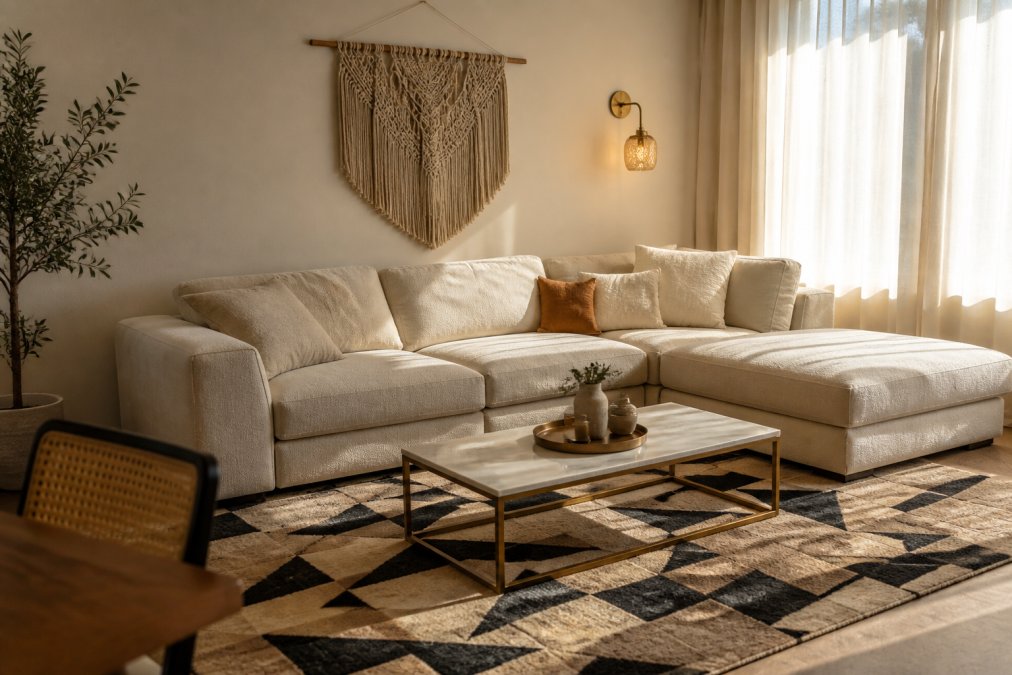
A common mistake is inverting this ratio. If you buy a statement sofa in bold bohemian print and add mid-century modern accents, the room fights itself. The dominant piece sets the tone.
| Element | 70% (Primary Style) | 30% (Secondary/Accent) |
|---|---|---|
| Sofa / seating | Primary style, neutral upholstery | Throw pillows, contrasting texture |
| Walls | Neutral backdrop or primary palette | One statement wall, art, sconces |
| Flooring | Consistent material throughout | Layered rug in secondary style |
| Lighting | Consistent fixture style | One statement pendant or sconce |
| Decorative objects | Cohesive material palette | Contrasting accent pieces |
How to Mix Patterns in Home Decor Without Visual Overwhelm
The rule is straightforward: vary the scale. Never put two patterns of the same size in the same visual field. A large-scale geometric and small-scale stripe work together; two medium-scale florals fight.
Scale and Proportion: The Secret to Pattern Harmony
Use this three-pattern formula:
- Large-scale pattern: The anchor (rug or statement upholstery)
- Medium-scale pattern: The bridge (throw, pillow grouping, or curtains)
- Small-scale pattern: The detail (decorative object, trim, or textured cushion)
Keep at least one pattern solid to give the eye a resting place. Color is the unifying factor. Patterns sharing even one color from the same palette read as cohesive. A geometric rug in terracotta and cream works with a floral pillow in rust and ivory because the color relationship holds.
Build Your Material Palette: Texture Layering and Furniture Silhouettes
Cohesive design doesn't require matching furniture, it requires a consistent material palette. Your material palette is the set of textures and finishes that repeat: warm wood tones, matte metals, woven naturals, smooth ceramics.
Texture layering stacks different surface qualities: smooth leather against nubby linen, polished marble next to rough jute. These contrasts create visual depth without requiring pattern or color drama.
Furniture silhouettes matter too. Choose a dominant silhouette (curved or angular) and use the opposite as your 30%.
Cohesive Home Decor Ideas That Work on Any Budget
The most effective approach is identifying the one or two elements that will do the most visual work and investing there first.
Budget-conscious sequencing:
- Start with the rug. A rug anchors the seating arrangement and establishes the color palette. It's the single highest-impact purchase.
- Add one statement textile. A throw or pillows in your secondary style create the 30% contrast without committing to furniture.
- Layer in lighting. Wall sconces and pendant lights change mood dramatically and cost less than furniture.
- Introduce a handmade element. A macrame wall hanging, ceramic vase, or woven basket adds texture and humanity.
- Edit, don't add. Before buying anything new, remove three things. A less-crowded room almost always looks more cohesive.
Using Rugs to Anchor a Space
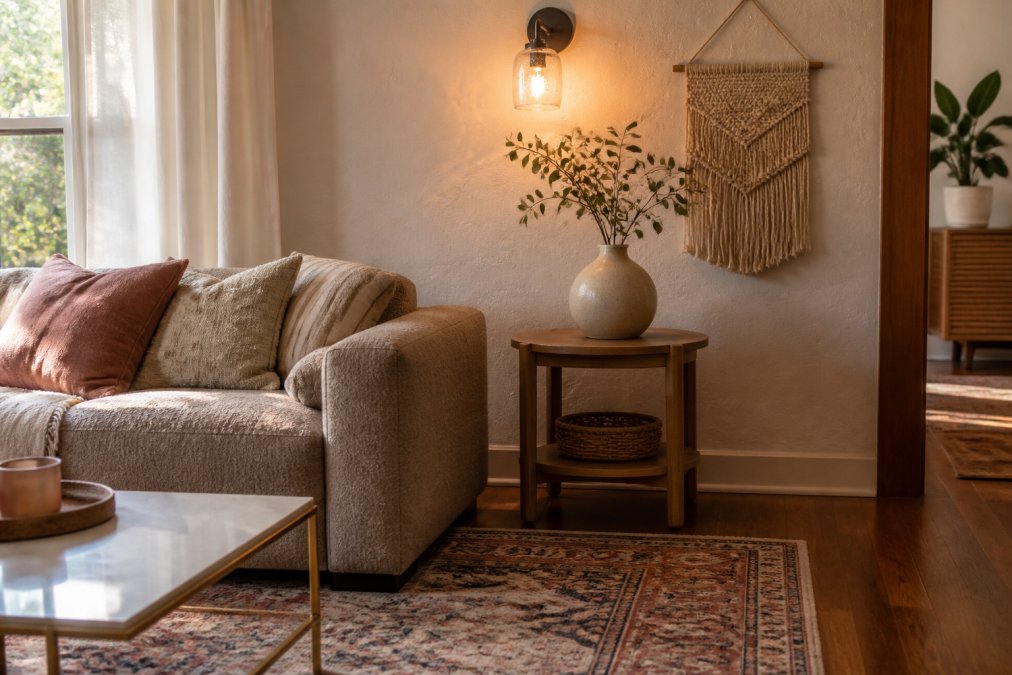
A rug defines the boundaries of a seating or dining arrangement. Without one, furniture floats. The most common mistake: buying a rug that's too small. All front legs of main seating pieces should sit on the rug, or all legs should sit on it.
The Station Home Design Geometric Patchwork Soft Floor Mat Rug shows how a geometric pattern bridges multiple design styles. Its patchwork structure reads as eclectic while geometric precision keeps it grounded.

For renters, a well-chosen rug is the single most transformative piece you can add. It defines zones, adds warmth, and travels with you.
Accent Pieces and the 80/20 Rule of Design
The 80/20 rule applied to decorative objects: 80% should reinforce the room's primary aesthetic, and 20% should introduce deliberate contrast. That 20% is where personality lives. A mid-century modern room with one unexpected bohemian macrame piece feels collected; five bohemian pieces create an identity crisis.
The 18 Inch Macrame Wall Hanging from Station Home Design is exactly the kind of piece that earns its place in the 20%: handmade texture, available in 18 color choices, calibrated to fit almost any primary palette.

How to Edit and Curate Your Collection Like a Designer
Editing separates a styled room from a cluttered one. Most people are good at acquiring; almost nobody is good at removing.
A designer's editing process:
Step 1: Clear the room mentally. What are the three or four pieces you'd bring back first? Those are your anchors.
Step 2: Apply the throughline test. Does each piece connect to your identified throughline? If you have to work hard to justify it, it probably doesn't belong.
Step 3: Check visual weight. Does one corner feel heavy while another feels bare? Redistribute before adding anything new.
Step 4: Use symmetry and asymmetry intentionally. Symmetry creates calm; asymmetry creates energy. Most well-designed rooms use symmetry as the base structure with asymmetric accents layered on top.
Step 5: Leave breathing room. A shelf with five well-chosen objects reads as curated; twenty objects reads as storage. The objects you don't display make the ones you do display look better.
The editing phase is where most design projects succeed or stall. Homeowners tend to add; designers tend to subtract.
Pulling together a space that reflects your personality while staying visually cohesive is learnable. Station Home Design offers a thoughtfully curated collection of home decor and furnishings designed to help you build exactly that kind of space. From the Modern Oversized Modular Chenille Sectional Sofa that anchors your 70% to the accent pieces that make the 30% count, every piece brings warmth and effortless style into your home. Start building a space that tells your story.
Frequently Asked Questions
What is the 70/30 rule in decorating?
The 70/30 rule means your dominant design style should fill roughly 70% of a room, while a secondary or contrasting style covers the remaining 30%. For example, if your primary aesthetic is mid-century modern, about 70% of your furniture and decor reflects that look. The remaining 30% can introduce bohemian textures, industrial accents, or Scandinavian minimalism. This split creates visual interest without tipping into chaos. It gives your space a clear identity while leaving room for personality.
How do you make different furniture styles look good together?
The key is finding a common thread, a shared color palette, a repeated material, or a consistent scale and proportion across pieces. A mid-century modern sofa can sit comfortably next to an industrial coffee table if both share similar visual weight and a neutral backdrop ties them together. Repeating one finish, like matte black hardware or natural wood tones, across otherwise different pieces creates design harmony. Mixing home decor styles works best when at least one element connects every piece in the room.
How can I mix modern and traditional decor without it looking messy?
Start by choosing a neutral backdrop, walls, large upholstery pieces, and rugs in calm, consistent tones. Then introduce traditional elements as accent pieces rather than dominant furniture. A traditional framed mirror or a classic ceramic lamp can coexist with a clean-lined modern sofa when the color palette stays consistent. Avoid splitting the room down the middle between styles. Instead, let one style lead and the other support, following the 70/30 design rule to keep the overall look intentional rather than accidental.
What is the 3-5-7 rule in decorating?
The 3-5-7 rule is a decorating guideline that suggests grouping objects in odd numbers, three, five, or seven items, to create visual interest. Odd groupings feel more natural and dynamic than even pairs, which can look too symmetrical and stiff. When arranging accent pieces on a shelf or console table, a cluster of three items at varying heights will almost always look more curated than two matching objects. The rule applies to decorative objects, throw pillows, and even gallery wall arrangements.
This article was written using GrandRanker
Frequently Asked Questions
What is the 70/30 rule in decorating?
The 70/30 rule means your dominant design style should fill roughly 70% of a room, while a secondary or contrasting style covers the remaining 30%. For example, if your primary aesthetic is mid-century modern, about 70% of your furniture and decor reflects that look. The remaining 30% can introduce bohemian textures, industrial accents, or Scandinavian minimalism. This split creates visual interest without tipping into chaos. It gives your space a clear identity while leaving room for personality.
How do you make different furniture styles look good together?
The key is finding a common thread — a shared color palette, a repeated material, or a consistent scale and proportion across pieces. A mid-century modern sofa can sit comfortably next to an industrial coffee table if both share similar visual weight and a neutral backdrop ties them together. Repeating one finish, like matte black hardware or natural wood tones, across otherwise different pieces creates design harmony. Mixing home decor styles works best when at least one element connects every piece in the room.
How can I mix modern and traditional decor without it looking messy?
Start by choosing a neutral backdrop — walls, large upholstery pieces, and rugs in calm, consistent tones. Then introduce traditional elements as accent pieces rather than dominant furniture. A traditional framed mirror or a classic ceramic lamp can coexist with a clean-lined modern sofa when the color palette stays consistent. Avoid splitting the room down the middle between styles. Instead, let one style lead and the other support, following the 70/30 design rule to keep the overall look intentional rather than accidental.
What is the 3-5-7 rule in decorating?
The 3-5-7 rule is a decorating guideline that suggests grouping objects in odd numbers — three, five, or seven items — to create visual interest. Odd groupings feel more natural and dynamic than even pairs, which can look too symmetrical and stiff. When arranging accent pieces on a shelf or console table, a cluster of three items at varying heights will almost always look more curated than two matching objects. The rule applies to decorative objects, throw pillows, and even gallery wall arrangements.